
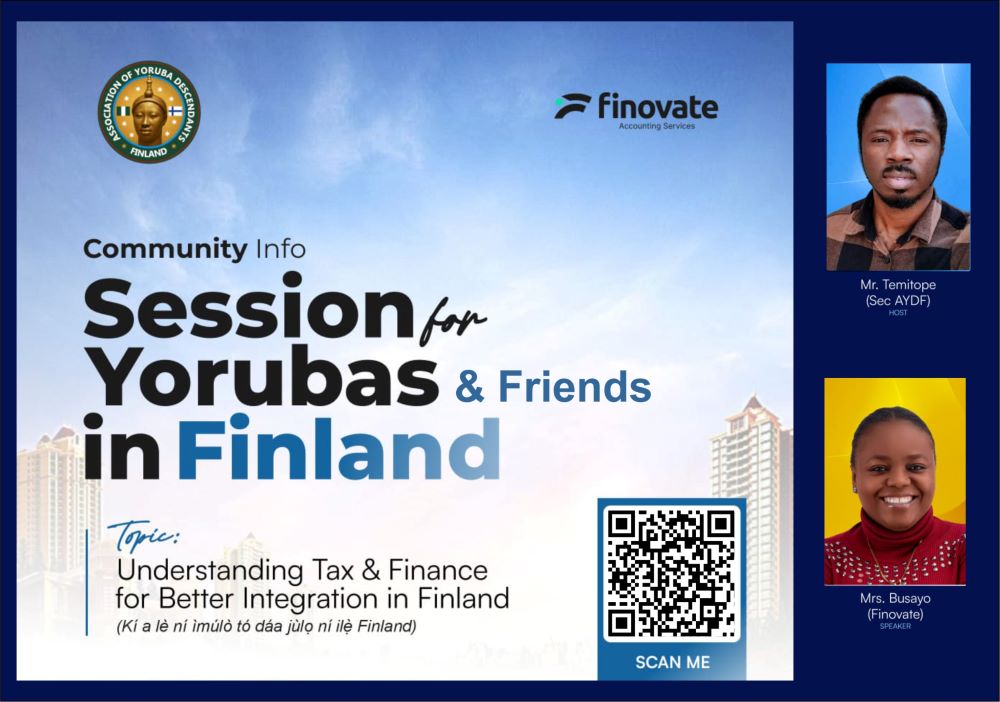
Community Tax Info Session Recap: Navigating Taxes and Finances in Finland
On September 20, 2025, our community hosted an insightful info session hosted by Temitope Ajayi, Secretary General of AYDF and a lecture delivered by Mrs. Busayo Apanishile, an experienced accountant and advisor at Finovate, to help immigrants, students, and residents better understand taxes, budgeting, and financial systems in Finland. The session, attended by participants from cities like Espoo, Tampere, Helsinki, and beyond, offered practical guidance for better financial integration. Here’s a recap of the key takeaways and actionable advice shared during the event.
Finnish Tax Basics: Your Tax Card and Annual Returns
Mrs. Apanishile emphasized the importance of securing a tax card before your first payday. This document estimates your annual income and ensures your employer withholds the correct tax percentage. Without it, employers may deduct up to 60% of your salary, though overpaid taxes can be refunded at year-end. You can obtain your tax card via the OmaVero online portal or by contacting the tax administration office. Finovate Repsult also offers support for this process.
Annual tax returns are pre-filled by the Finnish Tax Administration based on data from your employer and family composition. It’s crucial to log into OmaVero to verify this information and claim deductions for expenses like:
-
Travel expenses: Beyond the standard €750 threshold for commuting costs.
-
Work-related expenses: Costs for tools, uniforms, or training that enhance your work.
-
Remote workspace: A portion of rent for a dedicated home office space.
-
Trade union fees: Membership fees are tax-deductible and provide unemployment benefits (up to 70% of your last salary if you lose your job).
-
Charitable donations: Donations to registered organizations, like the Red Cross, may qualify for deductions.
Corrections to your tax return can be made for up to three years back (e.g., 2022–2024 in 2025) to claim missed deductions.
Budgeting with the 70-10-10-10 Rule
To build a strong financial foundation, Mrs. Apanishile introduced the 70-10-10-10 rule for managing your net salary (after taxes):
-
70% for living expenses: Covers rent, utilities, food, transportation, and phone bills.
-
10% for personal development/giving back: Includes hobbies, entertainment, or charitable contributions (e.g., tithes for Christians).
-
10% for short-term savings: An emergency fund or savings for goals like vacations or replacing a laptop.
-
10% for long-term savings/investments: For future security, ideally placed in high-interest accounts.
For example, with a €1,500 net salary, €1,050 would go to living expenses, €150 to personal development, €150 to short-term savings, and €150 to long-term savings. Finnish bank accounts allow you to create separate accounts for short- and long-term savings to stay organized.
Kela Benefits: Support for All
Kela, Finland’s social security system, supports not just the unemployed but also students, parents, and those with health issues. Eligibility depends on residency and income level. Mrs. Apanishile encouraged attendees to contact Kela directly to explore benefits, as applications are straightforward and can often be handled over the phone. Key benefits include:
-
Health insurance for students: Access to student clinics for medical and dental care at no cost.
-
Unemployment benefits: Available through Kela or trade unions (offering up to 70% of your last salary if part of a union).
-
Housing allowance: Available even for employed individuals, based on household expenses.
-
Child benefits and parental allowances: Support for families and expecting parents.
Entrepreneurship: Sole Trader vs. Limited Liability Company
For aspiring entrepreneurs, choosing a business structure is key:
-
Sole Trader (Toiminimi): Simpler to register, but your personal assets are tied to business liabilities.
-
Limited Liability Company (Oy): A separate legal entity, protecting personal assets but with more complex registration.
Entrepreneurs should open a separate bank account for business transactions to simplify bookkeeping. VAT registration is mandatory if your turnover exceeds €20,000 annually (2025 threshold), but voluntary registration can allow you to reclaim VAT on expenses. Corporate income tax applies to Oys, while personal income tax is calculated for sole traders based on annual profits. Mrs. Apanishile recommended a tax prepayment plan for sole traders to avoid large year-end tax bills.
Pension insurance (YEL) is mandatory for entrepreneurs earning over €9,285 annually and is tax-deductible. Even if not required, it’s a wise investment for future financial security.
Q&A Highlights
The session included a lively Q&A, addressing practical concerns:
-
Student Health Insurance: Students can access health services through YTHS (Finnish Student Health Service) without needing to contact Kela directly.
-
Freelancer Taxes: Use invoicing services (e.g., Finovate or Trust) to simplify tax calculations, as they withhold taxes based on your tax card.
-
Tax on Earnings Over €15,000: Taxes are calculated only on income exceeding €15,000 (e.g., €3,000 for an €18,000 income), but the tax rate is prorated across the year for easier payments.
-
Pensions for Entrepreneurs: Even if your employer provides a pension, setting up a separate YEL pension for your business is advisable for greater retirement security.
Personal Stories and Community Advice
Attendees shared experiences, highlighting the importance of seeking information. One participant recounted challenges accessing entrepreneurial grants due to unclear instructions, emphasizing the need for guidance. Mrs. Apanishile shared a story of a client who secured Finnish citizenship by maintaining proper tax records, underscoring the value of staying “in the system” to avoid issues with immigration or fines.
Join the Community
The session reinforced the power of community and information-sharing. Attendees were encouraged to join the Yoruba community group for updates on future sessions, including topics like job searching and CV creation. Mrs. Apanishile’s contact information and relevant links (e.g., tax office, Kela, YTHS) were shared for further assistance.
Final Thoughts
This session was a goldmine of practical advice for navigating Finland’s financial landscape. Whether you’re a new immigrant, student, or entrepreneur, understanding taxes, budgeting, and Kela benefits is key to thriving in Finland. Stay informed, connect with the community, and don’t hesitate to reach out to experts like Mrs. Apanishile at Finovate for personalized guidance.
Missed the session? The recording will be available soon, check the community group for the link. Stay tuned for more workshops to support your integration and success in Finland!